
Tips On Mental Enrichment for Pets: Why It Matters and How to Do It Correctly
For decades, pet care meant food, water, shelter, and the occasional trip to the vet. Today, that baseline is no longer enough — and pet owners know it. A fast-growing movement in animal care is putting mental enrichment for pets at the center of what it means to truly care for a pet. Whether you share your home with a dog, a cat, a parrot, a bearded dragon, or a ferret, the science is clear: a mentally stimulated pet is a healthier, happier, better-behaved pet.
What Is The Growing Trend Toward Pet Mental Enrichment?
The shift in how we think about pet wellness has been building for years, but it has accelerated sharply in the last decade. Several forces are driving it.
Pets are increasingly viewed as family members rather than animals that live in or around the home. As that relationship deepens, owners are more attuned to their pets’ emotional states — noticing anxiety, boredom, frustration, and depression in ways previous generations simply did not. Veterinary behaviorists and animal cognition researchers have simultaneously produced a wave of science confirming what many owners suspected: animals experience complex emotional lives and suffer real consequences when their mental needs go unmet.
At the same time, the rise of social media has created a global community of engaged pet owners sharing enrichment ideas, products, and results in real time. Puzzle feeders, foraging mats, DIY enrichment setups, and species-appropriate sensory experiences now have dedicated followings across every major platform. The pet industry has responded with a flood of pet-enrichment-focused products. According to the American Pet Products Association, U.S. pet industry spending has surpassed $150 billion annually — with enrichment toys, accessories, and specialty foods among the fastest-growing categories.
This is not a niche trend. It is becoming the standard of care for pets.
What Is Mental and Emotional Enrichment for Pets?
Mental enrichment for pets refers to activities, environments, and interactions that stimulate an animal’s mind, satisfy natural instincts, and support emotional wellbeing. It goes beyond physical exercise to address the cognitive and psychological needs that are just as real — and just as important — as nutritional or medical needs.
When a pet lacks mental stimulation, the results are predictable: destructive behavior, excessive vocalization, repetitive movements, aggression, withdrawal, and a general decline in quality of life. When enrichment is provided consistently, animals are calmer, more curious, more confident, and better able to cope with stress.
Enrichment falls into several broad categories that apply across species:
- Foraging and feeding enrichment: Making animals work for their food in ways that mimic natural hunting, grazing, or scavenging behaviors.
- Sensory enrichment: Engaging sight, smell, sound, taste, and touch with novel or naturalistic stimuli.
- Cognitive enrichment: Puzzles, problem-solving, and training that challenge the brain and reward curiosity.
- Social enrichment: Positive interaction with humans, other animals, or even recorded animal sounds and scents.
- Environmental enrichment: Expanding and varying the physical environment to encourage exploration, climbing, hiding, and natural movement.
What Are Examples of Mental Enrichment For Pets By Species?
Mental Enrichment For Pets: Dogs
Dogs are highly intelligent, social animals with strong instincts to sniff, chase, chew, and problem-solve. A daily walk meets physical needs but rarely satisfies mental ones. Enrichment for dogs should tap into those natural drives.
- Sniff walks and scent work: Allowing a dog to stop and smell freely on a walk — or introducing structured nose work activities — engages the brain far more intensely than a fast-paced exercise walk. Scent detection games can tire a dog out more efficiently than physical exercise alone.
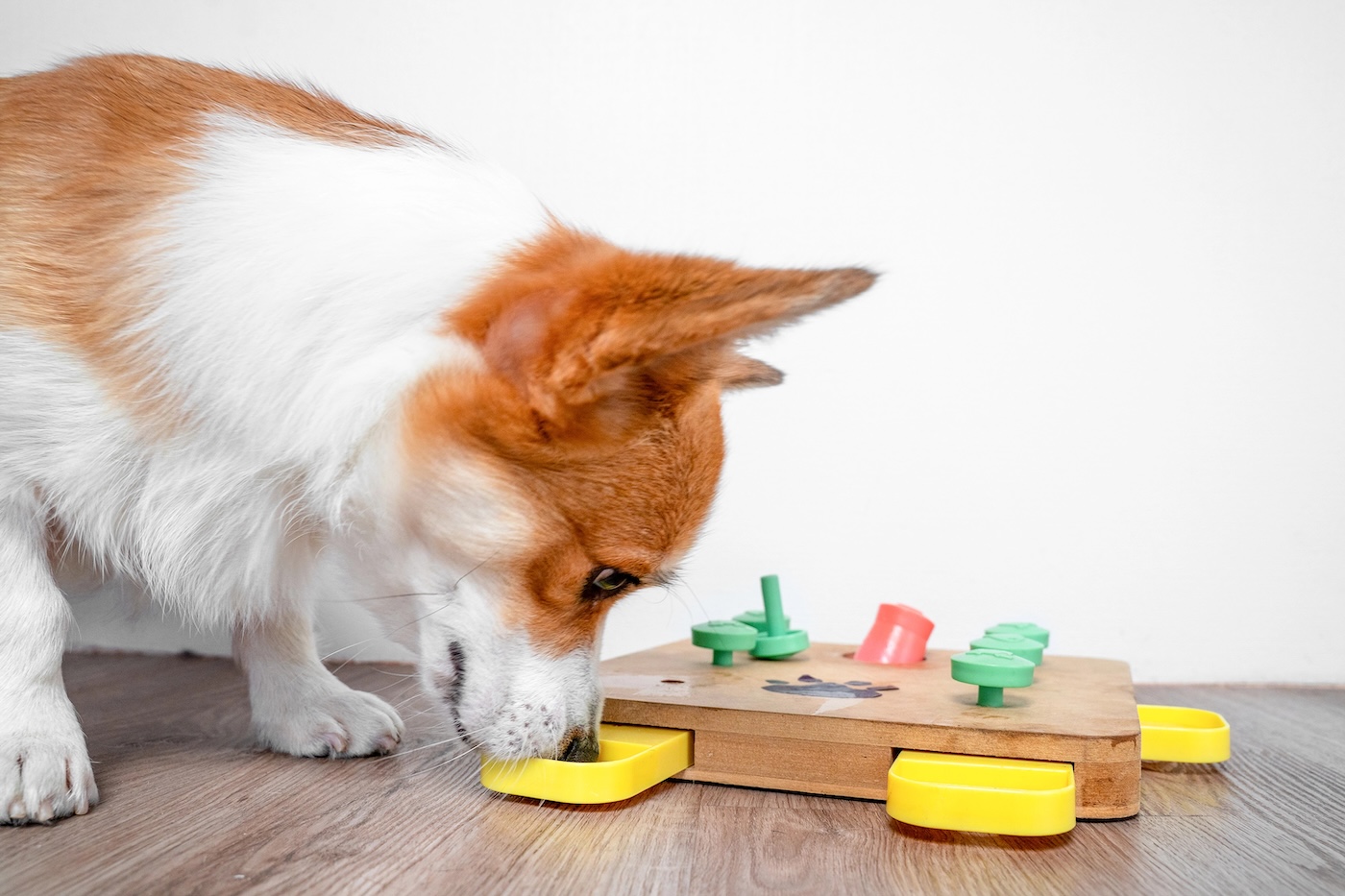
- Puzzle feeders and lick mats: Replacing the food bowl with a slow feeder, Kong, or lick mat turns mealtime into a problem-solving session. Freezing food in a Kong extends the activity and helps manage anxiety.
- Training and trick work: Short, positive training sessions engage a dog’s mind and strengthen the human-animal bond. Learning new commands — even silly tricks — gives dogs a sense of accomplishment and reduces frustration behaviors.
- Snuffle mats and foraging boxes: Hiding kibble or treats in a snuffle mat or cardboard box taps into natural foraging instincts and can be set up in minutes.
Mental Enrichment For Pets: Cats
Cats often are mischaracterized as low-maintenance and independent to the point of indifference. In reality, they are predatory animals with significant mental and sensory needs that go chronically unmet in typical indoor environments.
- Interactive play: Daily wand-toy sessions that mimic the hunt-catch-kill sequence satisfy predatory instincts and reduce stress. Rotating toys prevents habituation.
- Window perches and bird feeders: Positioning a perch near a window with outdoor bird or squirrel activity gives cats hours of visual and sensory engagement — sometimes called cat TV.
- Food puzzles and hunting feeders: Puzzle feeders, rolling treat balls, and hiding small amounts of food around the home encourage cats to hunt for their meals rather than eat from a static bowl.
- Vertical space and hiding spots: Cat trees, wall shelves, and tunnels allow cats to climb, survey their territory from height, and retreat to safety — all natural feline behaviors that support emotional regulation.
Mental Enrichment For Pets: Birds
Parrots, cockatiels, and other companion birds are among the most cognitively complex animals kept as pets. Many are as intelligent as young children and require daily mental engagement to remain emotionally stable.
- Foraging setups: Rather than offering food in a dish, hide food in paper cups, foraging boxes, or hanging foraging toys. Birds that forage are measurably calmer and less likely to develop feather-destructive behaviors.
- Novel items and shreddable toys: Rotating novel items — paper, cardboard, safe wood, palm leaves — into the cage gives birds something to investigate and destroy, satisfying strong foraging and chewing instincts.
- Training and free-flight time: Teaching a bird to step up, target-train, or perform simple behaviors builds confidence and gives these highly social species the structured interaction they crave.
Mental Enrichment for Pets: Reptiles
Reptiles are frequently assumed to have no enrichment needs. Research increasingly challenges that assumption. Snakes, lizards, and turtles demonstrate curiosity, spatial learning, and stress responses that point to genuine psychological needs.
- Varied terrain and hides: Adding rocks, branches, tunnels, and multiple hides to an enclosure encourages natural exploratory behavior. Bearded dragons and monitors in particular benefit from more complex environments.
- Food foraging: Hiding food around the enclosure encourages foraging.
- Supervised exploration: Allowing a reptile supervised time outside its enclosure to explore a safe space engages curiosity and provides sensory novelty that a static habitat cannot.
Mental Enrichment For Pets: Ferrets & Exotic Mammals
Ferrets are intensely curious, highly active, and easily bored. They are carnivores with strong predatory instincts and a deep need to tunnel, explore, and play.
- Tunnels and dig boxes: Providing tunnels, fleece tubes, and boxes filled with rice, shredded paper, or safe packing materials satisfies the ferret’s strong burrowing instinct.
- Prey-mimicking play: Dragging a toy along the ground or using a wand-style toy that mimics prey movement engages predatory drive and physical energy simultaneously.
- Rotation of play spaces: Ferrets habituate quickly. Regularly changing their play area layout, adding new objects, or rotating toys keeps the environment novel and engaging.
Pet Mental Enrichment: A Growing Trend That Improves Pet’s Quality of Life
Mental enrichment for pets is no longer a luxury — it is a core component of responsible, modern pet care. Across every species, the evidence points to the same conclusion: animals that receive consistent mental and emotional stimulation live longer, healthier, happier lives, and are far easier to live with.
The good news is that enrichment does not have to be expensive or time-consuming. It requires curiosity, consistency, and a willingness to see the world from your pet’s perspective. Start small, rotate often, and pay attention to what engages your individual animal. The results will speak for themselves.
Need strategies on mental enrichment for your dogs, cats, birds, reptiles, or exotic mammals? Schedule a consult with Alford Avenue Veterinary Hospital today!